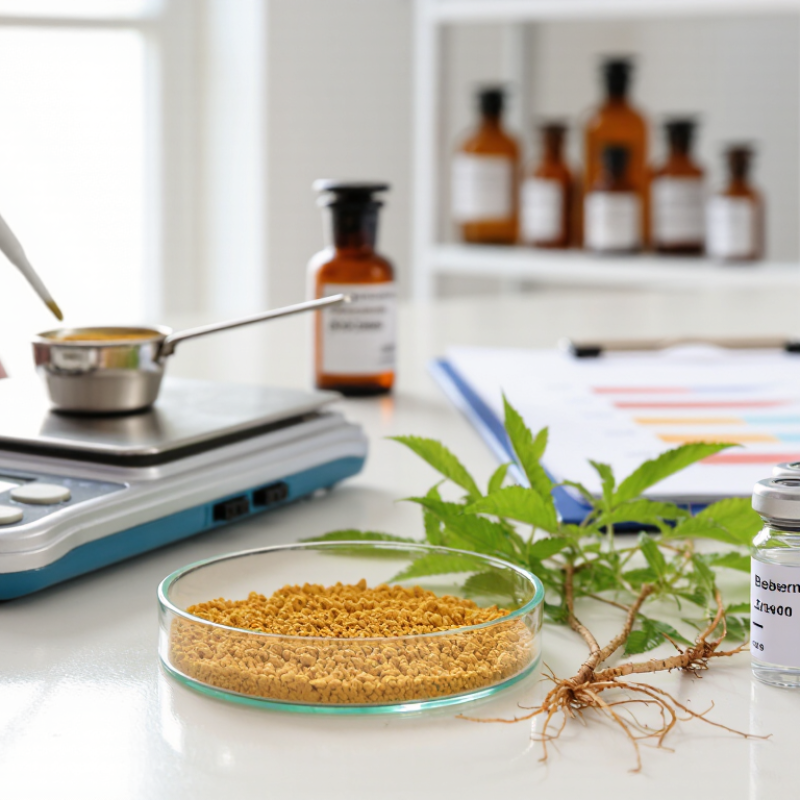
| Botanical source |
State the botanical species and plant part, such as Coptis chinensis (rhizome), Phellodendron amurense (bark), or a specified Berberis species (root or bark). |
Berberine content and accompanying alkaloids can vary by species, plant part, and processing. |
Botanical identity statement, plant-part declaration, and traceable raw-material records. |
| Ingredient identity |
Clarify whether the product is a botanical extract standardized for berberine or berberine hydrochloride (berberine HCl) as an isolated ingredient. |
A 97–99% assay claim is not interchangeable with the percentage of berberine in a crude or standardized plant extract. |
Product specification identifying the exact chemical or botanical ingredient and its declared assay basis. |
| Form and appearance |
Specify the supplied form (for example, powder or granules), color, odor, and any carrier or excipient. Request the particle-size range if relevant to processing. |
Form and excipients affect handling, blending, formulation, and the interpretation of assay results. |
Current product specification, including excipient disclosure and relevant physical properties. |
| HPLC assay: 97–99% |
If this range is required, define the analyte (for example, berberine HCl), acceptance range, test method, and whether results are reported on an as-is or dried basis. |
Assay values are comparable only when the analyte, calculation basis, and validated method are clearly stated. Do not assume the range applies to every botanical extract. |
Batch-specific certificate of analysis (CoA) with HPLC method reference, result, units, and reporting basis. |
| HPLC method and identity |
Ask how the peak is identified and quantified, including reference standard, sample preparation, and whether the method distinguishes berberine from related alkaloids. |
A stated percentage alone does not show how the result was established or whether the method is suitable for the ingredient. |
Method summary or validation information and a representative chromatogram, where available. |
| Moisture and loss on drying |
Set an appropriate limit for the specific ingredient and state the test method and reporting basis. |
Moisture can affect stability and the relationship between as-is and dried-basis assay results. |
Batch CoA showing the result, method, and applicable specification limit. |
| Contaminants and microbiology |
Define applicable limits for heavy metals, pesticide residues, residual solvents (if used), and microbiological tests based on the intended market and product category. |
Requirements vary by jurisdiction, application, and customer quality standard; use the relevant current requirements rather than assuming one universal limit. |
Batch test results from qualified laboratories and the applicable regulatory or customer specification. |
| Traceability and consistency |
Confirm lot identification, change-control practices, and whether specifications are applied consistently across production batches. |
Traceability supports investigation of out-of-specification results and verification of batch-to-batch consistency. |
Lot-specific CoA, traceability information, and documented quality-system controls. |
| Packaging and storage |
Specify packaging, storage conditions, retest or expiry date, and any protection needed from moisture or light according to product stability data. |
Suitable packaging and storage help preserve quality during transport and storage. |
Label information, stability or shelf-life support, and written storage instructions. |